Weekly route
Yard Maintenance
Mowing, fertilizing and the ordinary ground maintenance that keeps a Wellington property from slipping between visits, booked as a season contract so the same crew comes the same day.
Chapter 01
Cut height through an Ohio summer
A mower does not run one setting all season. Early in the year, while the grass is still catching up from winter, the cut sits lower to clear old growth and let light reach the crown. Once the dry stretch of July and August sets in, the blade goes up. A taller cut leaves more leaf to shade its own roots and hold what little moisture the ground still has, and it is the single biggest factor in whether a lawn stays green through a dry Ohio summer or goes brown and stays there.
Cutting too short in a dry month does real, visible damage: scalped patches that take weeks to recover, thatch buildup where the grass tries to compensate, and roots that never get deep enough to reach water on their own. Reading the yard rather than just running the same setting all year is most of what separates a lawn that holds up in August from one that does not.
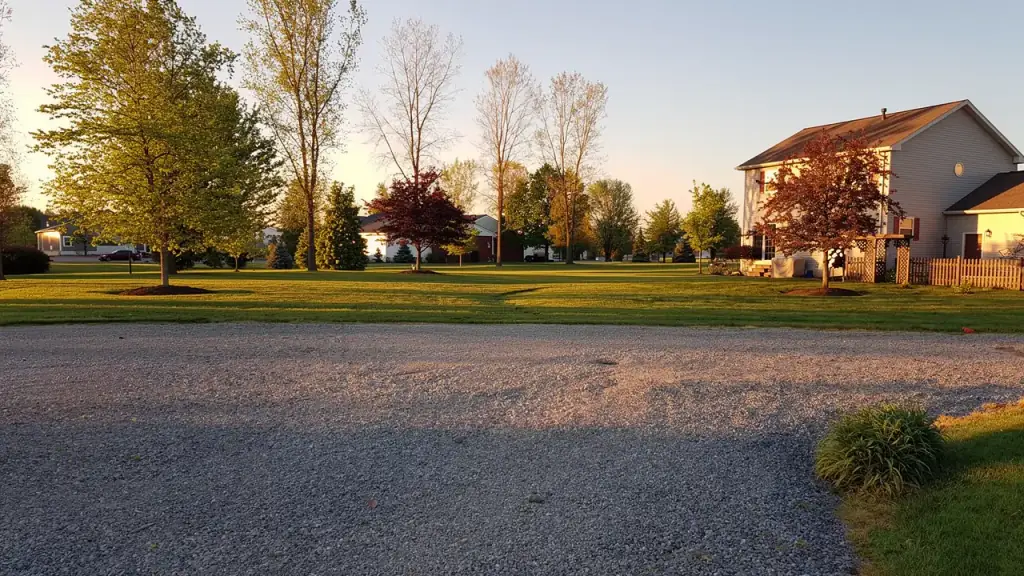
A mown rural Ohio property at golden hour with a gravel drive and mature trees
Clay soil, compaction and what Lorain County ground does to a lawn
Much of the ground around Wellington and LaGrange runs heavy clay under a thin topsoil layer, and clay does not drain or breathe the way a sandier soil does. Foot traffic, equipment, even a season of regular mowing on the same lines, packs it down further. Compacted clay holds water at the surface after rain instead of letting it soak through, and it starves roots of the air they need underneath, which is why the same section of a yard can go thin and patchy year after year no matter how much it gets watered.
Reading those signs, standing water that lingers longer than it should, grass that thins in the same spots each season, ground that feels hard underfoot even when it looks green, is part of the job before a mower ever gets there. What the crew can do about it on a routine visit is limited: raised cut height and fertilizing timed around the compacted areas rather than treated the same as the rest of the yard.
Chapter 03
The weekly route: same crew, same day, rain or not
A season contract puts a property on a fixed weekly slot rather than a queue of one-off calls, and that consistency is worth more than it sounds. The same crew coming back to the same yard week after week starts to know it, where the low spot holds water, which bed edge needs attention, where a downspout empties out, in a way a rotating crew never would.
Rain on the scheduled day does not mean the yard gets skipped, but it can mean the visit shifts. Mowing wet clay ground packs it down further and tears up turf that is already saturated, so the route gets reordered and that property gets caught on a drier day rather than mowed into the ground on schedule for its own sake.
Canon's — Fully insured, running newer equipment. Call (440) 759-8409.
Through the growing season
How the cut and the feed change across the year
A season contract does not run one setting from April to October. This is the shape it usually takes on a Lorain County property, adjusted to what that particular yard and that particular year are doing.
Apr / May
Spring green-up
Cut height starts lower to clear winter growth and get light down to the crown. Fertilizing on this stretch is timed to root growth, not a bag's calendar date.
Jun / Aug
The dry stretch
Blade height comes up as rain drops off. A taller cut shades its own roots and holds moisture the ground is not getting from the sky.
Sep / Oct
Fall recovery
Cut height eases back down as growth slows, and a second fertilizing pass feeds the roots ahead of dormancy rather than pushing top growth nobody needs.