Why Cutting Your Lawn Shorter in August Makes It Worse
The shorter cut that looks tidiest in July is usually the reason the same lawn goes brown by August.
September 15, 2026 · 3 min read
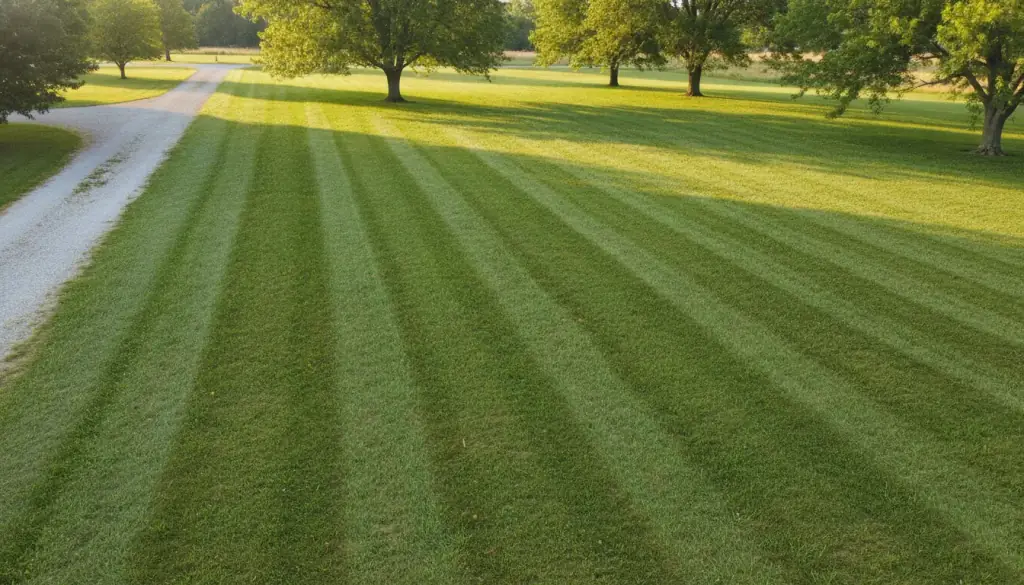
Every summer we get the same call. The mower's been set the same way for years, the lawn looked fine in June, and by the middle of July it's gone thin and straw colored in the sunniest spots. The cut height usually hasn't changed. The weather has.
Grass Blades Are Solar Panels
A blade of grass makes its own food through the part of it you cut off. Take more of that blade away and you take away the plant's capacity to feed its own roots. In spring, with cool nights and regular rain, a lawn can recover from a short cut in a few days. By July, with longer, hotter days and less rain to work with, that same short cut leaves the plant running on reserves it doesn't have.
Why Longer Grass Handles the Heat Better
Taller grass shades its own soil. That shade keeps the top couple of inches of ground cooler and slows how fast it dries out between waterings, which matters on the open, sun exposed yards we see a lot of out toward LaGrange and Grafton. Roots tend to grow to roughly the same depth as the grass is left standing, so a lawn kept a little taller through summer is also building a deeper root system underneath, one that can reach moisture a short cut lawn simply can't.
The Trade a Lot of People Don't Want to Make
We get why people resist this. A longer lawn looks a little less crisp than a tight, fresh cut one, especially right after mowing. But a lawn kept slightly taller through the hottest stretch of the year and mowed on a normal schedule looks better in the photo that matters, the one taken in late August, not the one taken the day after a cut.
- Raise the deck a notch (or two) once daytime highs are consistently in the 80s.
- Never take more than about a third of the blade length off in a single cut.
- Mow on a schedule, not a look. A stressed lawn regrown too fast between cuts is worse than one cut slightly early.
A Dull Blade Undoes All of This
Height matters, but a dull mower blade fights against it. A sharp blade cuts cleanly, and a clean cut seals fast. A dull one tears the tip of the blade instead of slicing it, which leaves a ragged, gray white edge visible across the whole lawn a day or two later if you look closely. That torn edge loses moisture faster than a clean cut and gives disease an easier way in, both things you're already trying to avoid by raising the deck in the first place. A blade that was sharp in April is usually not sharp by the middle of a full mowing season.
Watering Deep Beats Watering Often
Cut height and watering habits work against each other if they're not matched. A lawn watered lightly every evening trains its roots to stay shallow near the surface, right where the soil dries out fastest in July heat. A lawn watered less often but more thoroughly, enough to actually soak down several inches rather than just wet the top, pulls those roots deeper looking for it. Combined with a taller cut, that's the same idea twice over: build a root system that can outlast a dry stretch instead of one that needs rescuing every afternoon.
Bringing the Height Back Down
Once nights cool off and growth slows, usually somewhere around mid to late September here, you can start bringing the height back down. Do it over two or three cuts rather than one big drop, the same rule in reverse: never more than a third of the blade at once, even going the other direction.
This is most of why we run cut height as part of the plan rather than a fixed setting. A property mowed on a season contract gets the deck adjusted as the summer moves, and the blade kept sharp across the season, rather than either one left wherever it was set back in May. It's a small thing to get wrong, and it's the difference between a lawn that's still green at the end of August and one that's already given up.
Canon's Lawn Service, (440) 759-8409
Call (440) 759-8409More articles
Why We Time Fall Cleanup to the Trees, Not the Calendar
Maples and oaks don't read a calendar, and neither should a fall cleanup.
The Mulch Mistake That Slowly Kills Young Trees and Shrubs
The mulch pile that looks tidiest against a trunk is usually the one doing the most damage underneath.